Zakat That Stays in Your Own City
Every year, families who want to donate Zakat in Karachi set aside their Zakat and then ask the same question: will it reach the people who truly deserve it? That is the question the Karachi People Welfare Association (KPWA) exists to answer, not with words, but by doing the work. We are based at Korangi Crossing, Allah Wala Town, and our teams work in the neighbourhoods around us. Your Zakat does not travel far. It goes to deserving families in our own city, people our volunteers know by name.
Zakat is an amanah, a trust. We treat it that way. Money marked as Zakat goes only to eligible heads: food for families who cannot afford a month of ration, school support for children who would otherwise drop out, and medical help for patients who cannot pay for treatment. If you are ever unsure whether your Zakat fits a particular project, email us first at wealthspringusa5555@gmail.com. We will tell you plainly, before you donate.
How Much Zakat Should You Pay? The 2.5% Rule
In most common cases, eligible Muslims give 2.5% of qualifying wealth as Zakat. The exact calculation depends on the type of assets you hold and the Islamic rules that apply to them, so if your wealth includes business stock, property or investments, ask a scholar you trust before you work out the figure. What matters most is that the amount is worked out honestly and given to people entitled to receive it. When you donate to KPWA, say that your donation is Zakat, so it is recorded and spent under Zakat rules, and keep your receipt as your own record.
Who Can Receive Your Zakat?
The Quran identifies eight categories of people entitled to receive Zakat, including the poor and the needy. In practice at KPWA, that means food for families who cannot afford a month of ration, school support for children who would otherwise drop out, and medical help for patients who cannot pay for treatment. Zakat funds are kept to eligible heads, and if you are ever unsure whether your Zakat fits a particular project, email us first at wealthspringusa5555@gmail.com. We will tell you plainly, before you donate. To see what that giving looks like in practice, read how Zakat and community giving transform lives in Karachi.
Where Your Zakat Goes
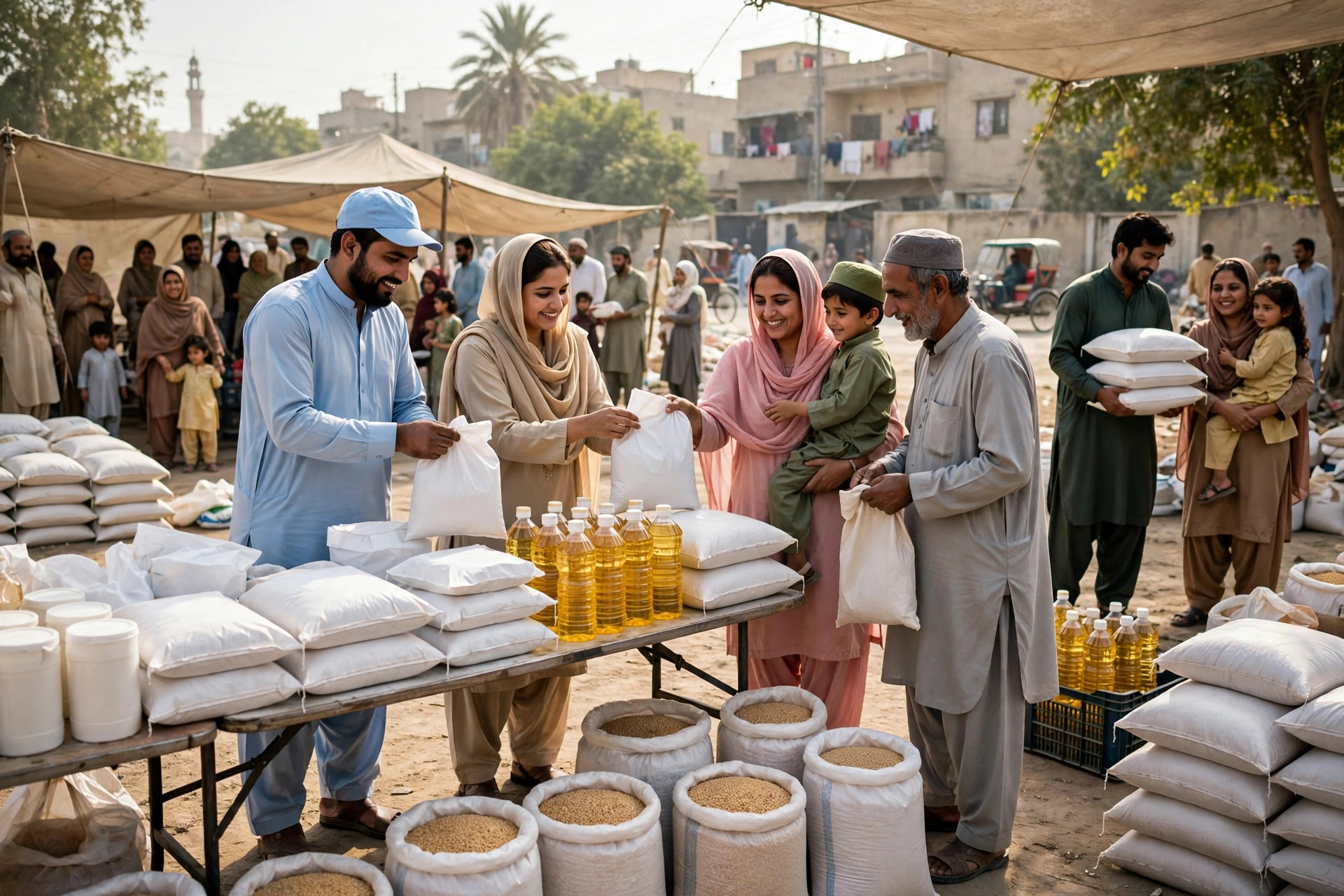
Most of the Zakat KPWA receives becomes ration. We aim to distribute ration packs to more than 500 families in Karachi: flour, rice, lentils, oil and the other essentials, packed and delivered by our own volunteers. One pack can carry a family through the hardest weeks of the month. For widows and daily-wage earners, it is often the difference between eating and going without.
Ramadan 2026 is the clearest picture of what that money does. We had 250 ration bags ready when more than 1,000 people arrived. There was no way to stretch 250 bags across that many families, until more donors came forward, more bags were packed, and every person who had come went home with one. That is Zakat doing what it is meant to do.
Zakat also keeps children in school and patients in treatment. KPWA supports more than 500 students with education sponsorship, and our healthcare work has reached more than 1,000 patients, including free eye medical camps in Korangi. Our volunteers have served more than 5,000 meals. None of this happens far away. It runs in the same streets where our donors live and work.
How to Donate Your Zakat
Giving your Zakat takes three steps. First, email us at wealthspringusa5555@gmail.com or visit the KPWA donate page. Second, say that your donation is Zakat, so it is recorded and spent under Zakat rules. Third, our team will guide you through the donation and confirm it personally, and send you a receipt. Any amount is welcome, there is no minimum, and every rupee goes to the families it was meant for. If you would rather give in person, come and visit us at Korangi Crossing, Allah Wala Town, Karachi, and see the work for yourself.
When you donate, please say that your donation is Zakat, so it is recorded and spent under Zakat rules. Any amount is welcome, there is no minimum, and every rupee goes to the families it was meant for. If you would rather give in person, come and visit us at Korangi Crossing, Allah Wala Town, Karachi, and see the work for yourself.
What Happens After You Donate Your Zakat
Your Zakat is recorded as Zakat and spent only on eligible heads: ration for families, schooling for children, treatment for patients. Because more than 50 volunteers give their time to pack ration, run camps, teach children and deliver relief, donations go to the work, not to overhead. We publish what we do, from ration drives to eye camps to winter clothing, and our donors hear back about where their money went. That is the whole point of giving close to home: you can check on it, visit it and question it. If you want to give your time as well as your Zakat, read how volunteering in Karachi works at KPWA, or see how to donate to charity in Karachi for other kinds of giving.
Why Donors Trust KPWA
KPWA is a local, volunteer-run charity. More than 50 volunteers give their time to pack ration, run camps, teach children and deliver relief. That means donations go to the work, not to overhead. We publish what we do, from ration drives to eye camps to winter clothing, and our donors hear back about where their money went.
Zakat is one of the most personal forms of giving. It deserves a charity you can check on, visit and question, one in your own city, spending your Zakat on the people living next door to you.
Read more: Zakat in Action: How Community Giving Transforms Lives • Donate to Charity in Karachi: How Your Donation Helps • Volunteering in Karachi: Join KPWA Volunteers
Frequently Asked Questions
How do I donate Zakat in Karachi with KPWA?
Email us at wealthspringusa5555@gmail.com or visit the KPWA donate page. Say that your donation is Zakat, and our team will guide you through the donation, confirm it personally and send you a receipt.
How much Zakat should I pay?
In most common cases, eligible Muslims give 2.5% of qualifying wealth as Zakat. The exact calculation depends on the type of assets you hold and the Islamic rules that apply to them, so ask a scholar you trust if you are unsure.
Who can receive my Zakat?
The Quran identifies eight categories of people entitled to receive Zakat, including the poor and the needy. At KPWA, Zakat funds food for families, school support for children and medical help for patients who cannot pay for treatment.
Will I get a receipt for my Zakat donation?
Yes. Email us at wealthspringusa5555@gmail.com and our team will share how to donate and send you a receipt.
Give Your Zakat Today
Your donation directly funds this work — healthcare, education and food security for families across Karachi.
Donate Now